

How do they Work?
The basics:
 |
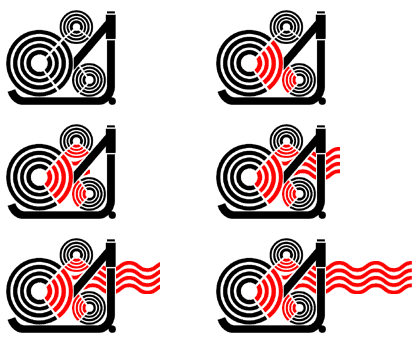
Traditional log placement channels heat upward and out of your chimney, leading to increased pollution , resource depletion and a reliance on other less green forms of energy, such as oil, coal, nuclear and electrical power. The Radiant Fire Grate holds logs in a way that forces heat forward and into your house. The diagram above shows how the logs form a concave shape that traps heat before projecting it outwards. The use of unsplit logs means a longer, "cleaner" burn, heating your house more efficiently and reducing your carbon emissions. |
For a more thorough (and technical) explanation, read on:
The heat contained in logs comes from the Sun. The Sun itself is basically a big ball of hydrogen formed some five billion years ago. Heat is developed when hydrogen fuses with helium, and the temperature increases outwards in the Sun's upper atmosphere reaching around 6,000 degrees Celsius, or 11,000 degrees Fahrenheit.
Fossil fuels contain solar energy stored from bygone ages. Wood is dependent on the sun for growth and trees belong to seed bearing plants, coniferous or softwoods (Gymnospermae) and hardwoods (Angiospermae).
Wood is composed of elongated cells, most of which are oriented in the longitudinal direction of the stem, which is why wood "seasons" from the ends regardless of size, and at the same rate. Wood will not season any faster if split into smaller pieces; it is split for sizing purposes, not seasoning. These cells consist mainly of cellulose, hemicellulose and lignin, all of which are organic and combustible.
Inorganic constituents exist in the bark of trees amounting to 2-5% of dry bark weight (determined as ash). It is from this bark that dioxins, furans and other undesirable emissions originate.
 Heating wood in the absence of oxygen is called pyrolysis and in the 19th century the process was used to produce methanol, turpentine, acetic acid, phenols and wood tar, all of which are organic or carbonaceous and combustible. Heating wood to just above 100 degrees Centigrade initiates some thermal decomposition, above 250 degrees it becomes more active and above 270 degrees it is exothermic, producing more and more heat.
During this heat increase, the process produces a mixture of carbon monoxide, hydrogen, methane and other gasses that can be burned to produce heat, or flashed off with other unburned bi-products.
The trick in a home heating appliance is to burn all of these by-products and waste nothing, thus cutting back on harmful emissions. We human beings live at the bottom of an ocean of air comprising 79.1% nitrogen and 20.9% oxygen. We not only breathe this oxygen, it is also a critical component in the burning of wood (and fossil fuels) and the operation of most motor vehicles. Trees and other vegetation act as the balance in the equation of the atmosphere, converting carbon dioxide back to oxygen in a process known as photosynthesis.
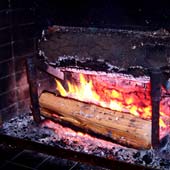
 When burning wood in an open fireplace, the trick is to capture and contain as much heat as possible within the combustion zone, and then transfer that heat into the room and not up the chimney.
By positioning the wood as shown above, and minimizing the influx of air from under the fire, a great deal of the heat generated in the combustion zone can be retained. The surfaces of the logs glow and radiate heat, also burning up particulates as in a jet engine's "after-burner".
The combustion heat converts itself to the infrared end of the spectrum of light, the same spectrum that heats the earth from the sun. Due to the concave arrangement of the stacked wood, heat is thrown out into the room, much as a concave mirror magnifies the image it reflects.

| Buy a Radiant Fire Grate Today! | ||||
| Easy to order, CDN$195.65(large size) or CDN$165.65(small size) | ||||
| orders processed using PayPal | ||||
| Free shipping in N.America | ||||
 |
||||
 |
||||
|


